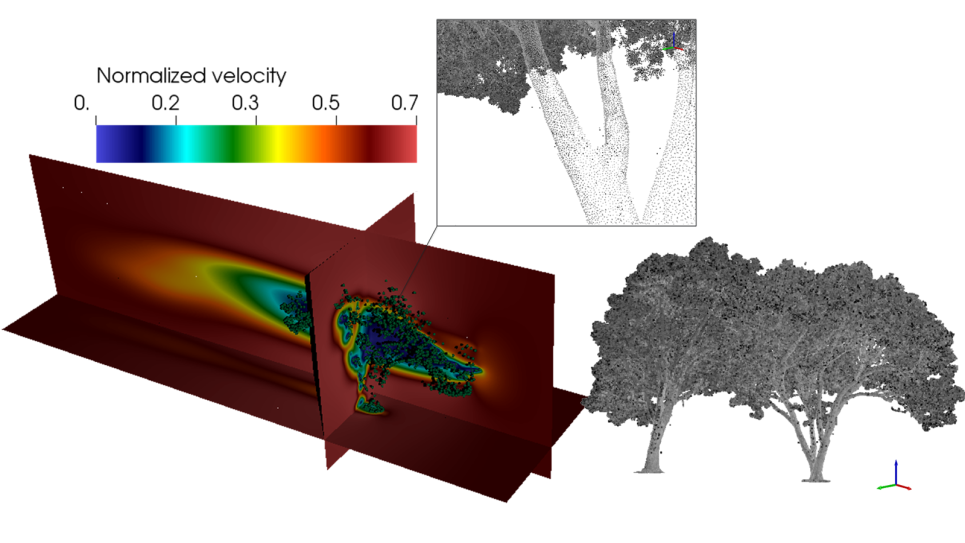
An example flow field for a real tree case from Lidar data by the United States Geological Survey. (Image: Zhuoting Wu, United States Geological Survey)
An example flow field for a real tree case from Lidar data by the United States Geological Survey. (Image: Zhuoting Wu, United States Geological Survey)
An example flow field for a real tree case from Lidar data by the United States Geological Survey. (Image: Zhuoting Wu, United States Geological Survey)
Interactive steering of large-scale scientific simulations promises to enhance scientific productivity by enabling real-time user intervention. However, existing in situ workflows typically rely on automated triggers and lack flexible human-in-the-loop control mechanisms. To address this gap, researchers developed a general-purpose bidirectional steering interface integrated with the Ascent framework, allowing scientists to pause simulations and interactively adjust parameters and workflows during runtime.
Traditional in situ analysis and visualization workflows for large-scale scientific simulations rely on automated triggers to execute tasks at predefined simulation states. While effective for many applications, these automated mechanisms limit the ability of scientists to interactively steer simulations in real time, especially when domain expertise is essential to determine appropriate interventions. Existing in situ frameworks either lack flexible bidirectional steering interfaces or require complex, simulation-specific customizations, creating a barrier to human-in-the-loop simulation control.
Researchers developed a novel, general-purpose bidirectional steering interface built on the Ascent in situ framework, enabling interactive human-in-the-loop control of existing simulations without requiring bespoke infrastructure. This interface supports registering, listing, and invoking simulation callbacks and system commands via two user steering interfaces: a lightweight terminal-based interface and a Jupyter-notebook interface connected through an SSH tunnel. Leveraging Ascent’s trigger infrastructure, simulations can be paused at key moments, allowing users to interactively adjust parameters, invoke callbacks, and resume execution without costly restarts.
Two use cases demonstrated the interface’s flexibility and productivity benefits. The first used a lattice Boltzmann CFD simulation to rescue unstable runs by interactively reverting to stable checkpoints and adjusting timestep sizes, successfully preventing crashes without restarting. The second optimized a vegetation canopy CFD simulation by dynamically swapping Lidar dataset resolutions and adjusting forcing parameters during runtime, thereby streamlining the process of finding optimal simulation parameters. In both cases, interactive steering reduced overhead, accelerated troubleshooting, and enabled nuanced scientific judgment in steering decisions. The team's work was recognized with the Best Paper award at the In Situ Infrastructures for Enabling Extreme-Scale Analysis and Visualization (ISAV 2024) Workshop at SC24.
This general-purpose bidirectional steering mechanism empowers scientists to perform real-time, human-in-the-loop interventions in large-scale simulations, improving efficiency and enabling more flexible exploratory workflows. Integrated into the widely used Ascent framework, it provides a practical path to advance interactive simulation steering across diverse scientific domains, addressing a critical gap in existing in situ methods. This capability holds promise to accelerate scientific discovery by allowing researchers to steer simulations responsively, reducing downtime and improving insight.
Sewell, A., D. K. Fytanidis, V. A. Mateevitsi, C. Harrison, N. Marsaglia, T. Marrinan, S. Rizzi, J. A. Insley, M. E. Papka, and S. Petruzza. “Bridging Gaps in Simulation Analysis through a General Purpose, Bidirectional Steering Interface with Ascent,” SC24-W: Workshops of the International Conference for High Performance Computing, Networking, Storage and Analysis (2024), IEEE.
https://doi.org/10.1109/SCW63240.2024.00119