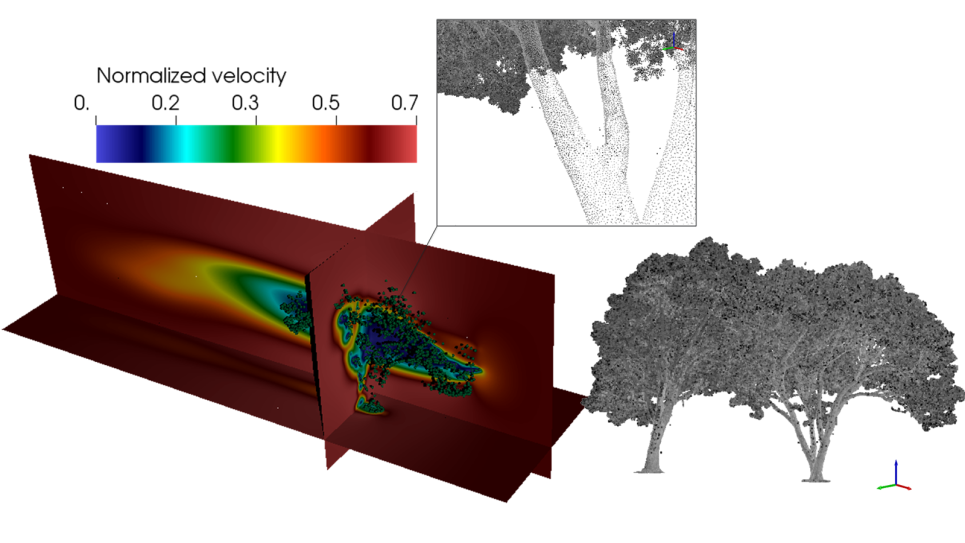
Solution-adaptive mesh refinement example of GURU autonomously setting up CFD simulations for high-speed aerodynamics. (Image: Allan Grosvenor, MSBAI)
Solution-adaptive mesh refinement example of GURU autonomously setting up CFD simulations for high-speed aerodynamics. (Image: Allan Grosvenor, MSBAI)
Solution-adaptive mesh refinement example of GURU autonomously setting up CFD simulations for high-speed aerodynamics. (Image: Allan Grosvenor, MSBAI)
Setting up high-fidelity simulations for complex engineering tasks, such as modeling aircraft aerodynamics or predicting satellite behavior, can take experts hours or even days to complete. These time-intensive processes remain a major barrier to broader use of high-performance computing (HPC) and simulation tools. To overcome this challenge, researchers at MSBAI are using ALCF computing resources to advance GURU, an AI-powered hybrid intelligence system that autonomously configures engineering simulations, enabling faster, more accessible use of HPC tools across industries.
Mission-critical simulation workflows demand decision-making that is not only fast and accurate, but also explainable, scalable, and adaptable to novel scenarios. Traditional AI models often struggle to meet all of these requirements: symbolic systems are interpretable but brittle, while deep learning approaches are powerful but opaque and inflexible. In simulation-driven engineering, this tradeoff has limited automation efforts—particularly in tasks like computational fluid dynamics (CFD) meshing, where incorrect configurations can lead to failure or unusable results. Bridging this gap requires a new AI architecture that combines the strengths of both symbolic reasoning and data-driven learning.
The MSBAI team developed a hybrid intelligence framework inspired by cognitive theories like Global Workspace Theory. Their system integrates multiple layers of AI agents—including symbolic rule-based systems, graph neural networks, reinforcement learning agents, and transformers—to automate end-to-end workflows. Using ALCF’s Aurora system, the team trained and scaled these agents across thousands of GPUs, applying them to complex CFD and space-domain awareness tasks. For CFD setup, they implemented an AutoML-guided optimizer capable of refining mesh parameters, while planning agents orchestrated workflow steps based on real-time performance feedback.
The GURU platform successfully automated the CFD mesh-generation process across hundreds of aircraft geometries. The system raised boundary-layer capture propagation from an initial 8 percent to 98 percent while cutting mesh failure rates from 88 percent to just 2 percent. Reinforcement learning agents, combined with symbolic constraints and context-aware embeddings, played a critical role in this success. The hybrid architecture also scaled efficiently on leadership-class systems, sustaining over 88 percent parallel efficiency on more than 1,000 compute nodes and showing strong performance in a second domain: detecting satellite maneuvers in near-real time.
This work demonstrates a powerful new model for AI-driven automation of engineering simulations. By blending symbolic logic with large-scale machine learning, the GURU platform offers a scalable, interpretable, and generalizable solution for accelerating HPC adoption across industries. Its success paves the way for broader integration of intelligent agents into simulation workflows for aerospace, energy, manufacturing, and beyond, advancing the DOE’s exascale computing goals and helping industry unlock massive design and innovation potential.
Grosvenor, A., A. Zemlyansky, A. Wahab, K. Bohachov, A. Dogan, and D. Deighan. “Hybrid Intelligence Systems for Reliable Automation: Advancing Knowledge Work and Autonomous Operations with Scalable AI Architectures,” Frontiers in Robotics and AI (July 2025), Frontiers Media.
https://doi.org/10.3389/frobt.2025.1566623